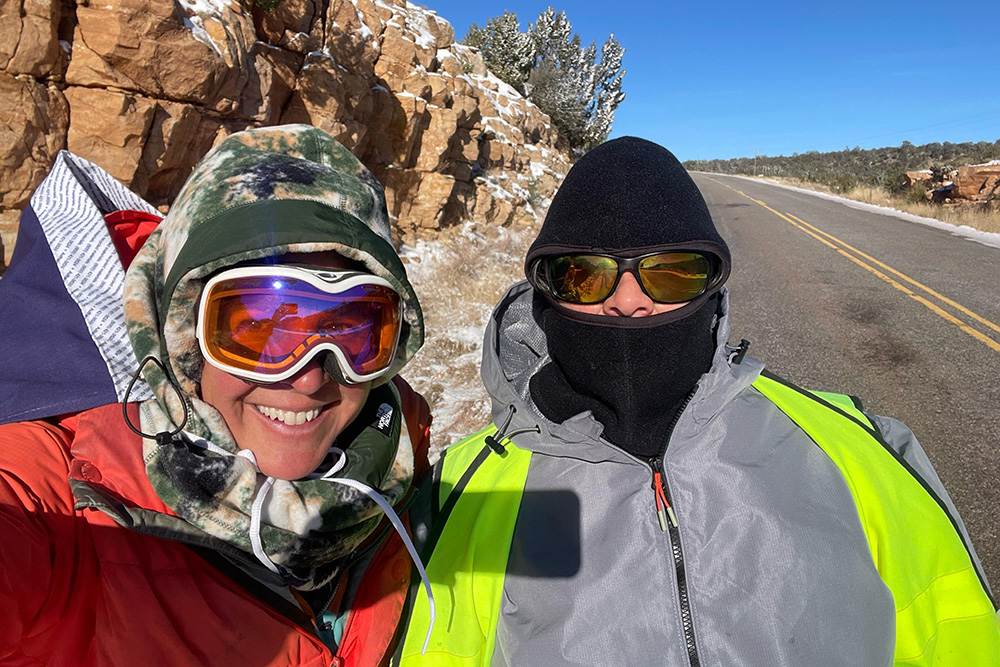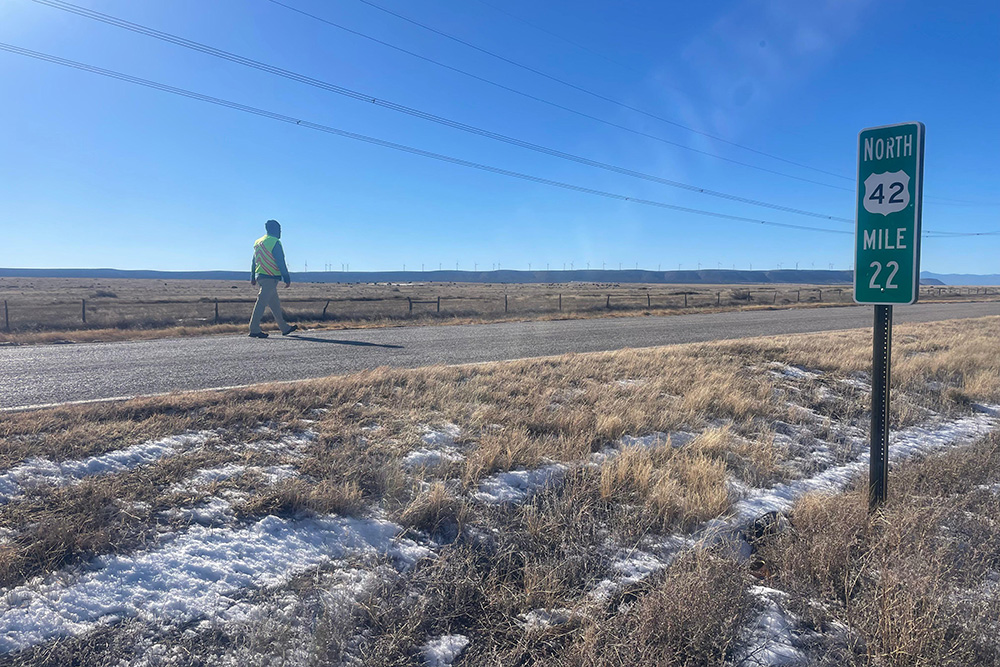
Day 17. Today we walked from Progresso to Willard continuing our deepening prayer for our beloved shared home and all who share in its life force.
As we walk, our feet touch land that is ancient, beautiful, and increasingly strained. We are walking for climate justice, and, as we do, we must speak also of migration, displacement, and the sacred human instinct to seek life, safety, and dignity. These realities are not separate. They are deeply, painfully, wholly intertwined.
Climate change is already forcing millions of people around the world to move in order to survive. When crops fail, when water disappears, when storms, floods, heat, and sea-level rise make whole regions unlivable, people do what humans have always done: they move. They search for stability. They protect their families. They follow hope. Migration is not a failure of character; it is a natural, responsive flow of life and also, too often, a response to unbearable conditions.
And yet, here in the United States, we live inside a bitter contradiction. This nation has contributed more than any other, historically, to the greenhouse gases that are destabilizing Earth’s climate. At the same time, its enabling of corrupt actors continues to stymie the bold energy transition that science and justice demand. And even more tragically, it increasingly turns its back on the very people whose lives are being upended by a crisis it helped create.
We are witnessing a moral collapse that links many forms of violence. There are intersections between all forms of injustice. Here, today, we consider this one: the doubling down on dirty fuels that poison air, water, land, and bodies, and the overt, vicious attacks on human beings who simply seek to live, work, and walk their paths in this world.
The same systems that exploit the Earth treat people as disposable.
The same logic that sacrifices ecosystems sacrifices migrants.
This is not accidental. It is structural. And it must be named.
I think about my own ancestors.
My paternal grandmother left England after surviving Hitler’s bombing of London.
My paternal grandfather came from France.
My maternal grandfather and great-grandparents came from Mexico.
They, too, were shaped by forces larger than themselves: war, instability, survival, hope. I honor them all. Their courage lives in me. Their journeys remind me that movement across land is not new. What is new is the scale of displacement being driven by a destabilized climate - and the painful gap between that reality and the struggle to properly respond to it.
Early in this pilgrimage, we were blessed to share a meal with a family who came to New Mexico from the Oaxaca area many years ago. They were generous and wise, feeding us abundantly and speaking with us about what it means to walk long distances across the land. An elder said something I will never forget:
“It is hard to walk a long way. When someone does that, they know their reasons very well. Otherwise they would not do it.”
He was honoring our reasons for walking—for love of Mother Earth, for justice, for future generations. And he was gently connecting those reasons to all the other reasons people walk: hunger, danger, drought, violence, hope. No one leaves home lightly. No one walks across deserts, borders, or uncertainty without clarity of purpose.
I think, too, of the story I heard on The Daily about a farming family in the Fertile Crescent region of Iraq. Their land, once fertile and sustaining, has been overtaken by desertification. Because of the lack of water, sustaining the cattle, sheep, goats, and buffalo they once kept is no longer possible and their crops are increasingly failing, as they struggle to hold onto their farming traditions and pass them onto their children. Their way of life is vanishing and their community is being driven to relocate into unknown and difficult futures. I have heard similar stories from Latin America, Africa, and Asia. The land changes, and people must change with it. Sometimes that change means leaving everything behind.
Here in New Mexico, we are not immune.
Drought is deepening.
A kind rancher in his eighties, named Clint, whom we met walking north of Roswell, told us his number one prayer is for moisture.
Many who live close to the land share this same prayer.
When we listen to the stories coming from other parts of the world, we are hearing our own future whispered to us. These are red flags. They are warnings. They are invitations to act before more land is lost, more lives are broken, and more harm and chaos engulfs us all.
Bold climate action is not optional. It is a moral imperative.
We need deep and immediate reductions in greenhouse gas emissions.
We need to stop burning fossil fuels as swiftly as we can.
And we need to stop fueling the oppressive, authoritarian-leaning systems that profit from fear, division, and destruction of both people and planet.
Immigration justice and climate justice are not separate struggles.
They rise from the same soil.
They are responses to the same broken systems.
To heal one without the other is to leave the wound open.
Our pilgrimage is not just about walking across land.
It is about walking toward a different way of being:
one that honors Earth,
one that protects human dignity,
one that tells the truth about responsibility and mutuality,
and one that refuses to weaponize lives and exacerbate suffering through willful ignorance.
When people move, it is because something sacred is at stake.
When the Earth cries out, it is because something sacred is being violated.
👉 As people of faith and conscience, we must act upon the connections between climate and migration. You can act today by supporting Somos Un Pueblo Unido on three essential bills for immigrant families:
- HB9 - The Immigrant Safety Act, to ensure that local governments in New Mexico do not enter into voluntary agreements to apprehend or detain community members for federal civil immigration enforcement.
- SB40 - The Driver Privacy & Safety Act, to establish clear guardrails so that automatic license plate reader surveillance data cannot be used to target undocumented drivers for immigration enforcement.
- HB124 - The creation of a permanent Office of New Americans within the Department of Workforce Solutions (DWS) to support immigrant integration and workforce development statewide—an essential step to increasing labor force participation and addressing critical workforce shortages across New Mexico.
Click on the Somos Un Pueblo Unido petition here to contact your legislators directly on these three bills!
May we learn to hear and do what we know is right - honoring what’s sacred as we create the world through which our children and grandchildren will move, adapt, and seek joyful futures.
- Desirée